How Still works
Two rooms.
One table.
Everything in Still lives in one of two places: your room, which no one else can ever see into, or the table between you, which only holds what you both agree to put there. The best way to understand it is to watch one thing cross — so here's the whole walk through the Table, with an invented couple, Maya and Dan, showing exactly what each of them sees. The rest of the house comes after.
We were at Sam's birthday dinner and you spent most of it on your phone. I sat there feeling like I'd come on my own. By the time we drove home I didn't want to talk at all.
Dan is writing his side. Maya can't see his words either — the blindness runs both ways.
You both left Sam's birthday lonely. Maya read the phone as “I'd rather be anywhere but here”. Dan was hiding in it from a week that had emptied him out. Neither of you wanted the silence in the car — and neither of you knew how to break it.
Dan doesn't know. And won't for a few minutes — on purpose, in case Maya wants to quietly take it back.
Saturday, at Sam's birthday dinner
Maya has put something on the Table. You're seeing its name and nothing else — that's by design. She hasn't seen anything of yours either.
Tell that evening the way it felt for you. Not a reply — there's nothing to reply to. Just your side.
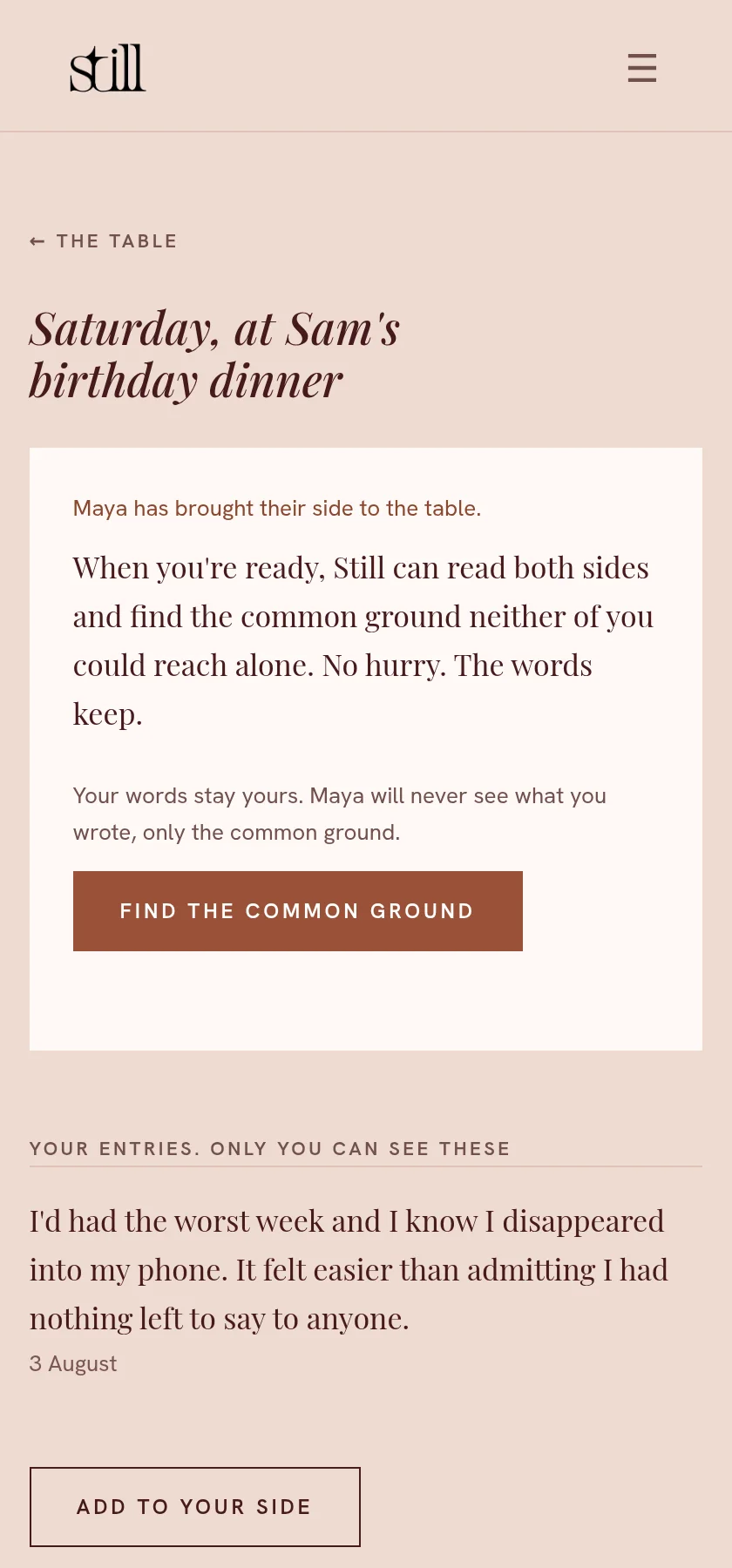
I'd had the worst week and I know I disappeared into my phone. It felt easier than admitting I had nothing left to say to anyone.
You both left Sam's birthday lonely. Maya read the phone as “I'd rather be anywhere but here”. Dan was hiding in it from a week that had emptied him out. Neither of you wanted the silence in the car — and neither of you knew how to break it.
-
Maya writes her side.
It starts in a room with the door shut. She tells it the way it felt — no structure, no audience, no one marking her words. Nothing she writes here is ever shown to Dan. Not summarised, not paraphrased. Never.
-
Only the name of it crosses the table.
Dan will see the thread's name and nothing else, so the name has to carry the moment on its own. “Saturday, at Sam's birthday dinner” tells him exactly which evening this is about. “You never listen” wouldn't — and Still helps you name the moment, not the accusation.
-
Dan writes his side — without reading hers.
This is the part that surprises people. Dan isn't shown what Maya wrote, on purpose. He's not writing a reply — he's telling his own side of the same evening. Blind on both sides is what keeps it honest: no rebuttals, no lawyering, no performing for an audience. If he'd rather sort through it privately first, there's a room for that too.
-
Still reads both. You get back only the common ground.
Nobody's words are handed over. Still reads both sides and writes the one thing neither of you could have written alone: the ground you're both standing on. You both see the same words, at the same time — and that's all either of you ever sees.
-
The common ground goes to work.
From here, Still helps each of you get ready to actually talk — in person, in your own words. Lines that land can be kept. And over time, what recurs across separate threads quietly shows up on your Us page as something worth noticing. The talking is always yours.
The proof
The actual screens, side by side.
Don't take the drawing's word for it. These are real screens from two test accounts — Maya's phone next to Dan's, at the same moment. Follow her words through all four moments: they render on her screen, and never once on his. What he gets is the name she chose — and, at the end, the same common ground she gets, on both screens at once.
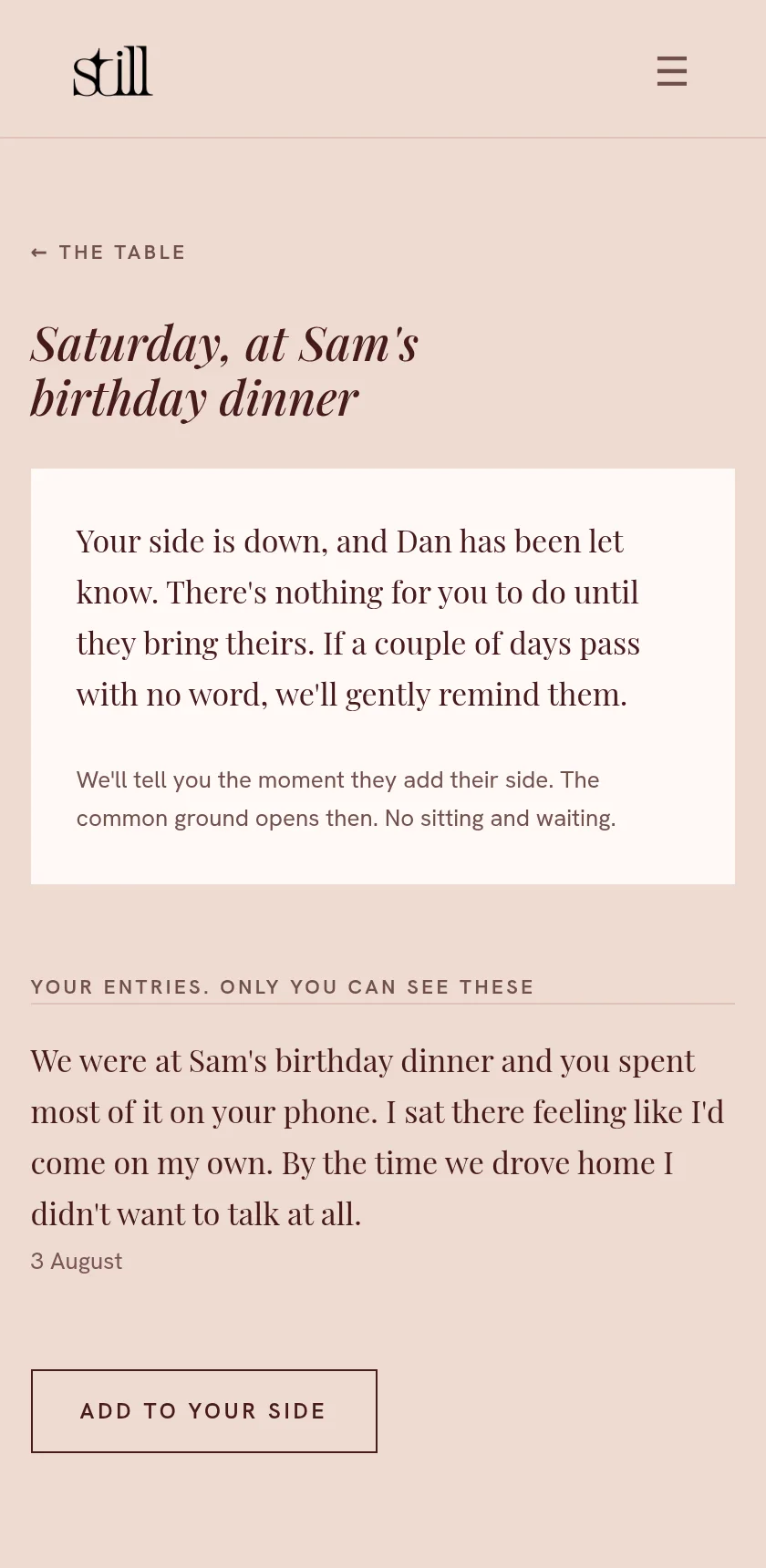
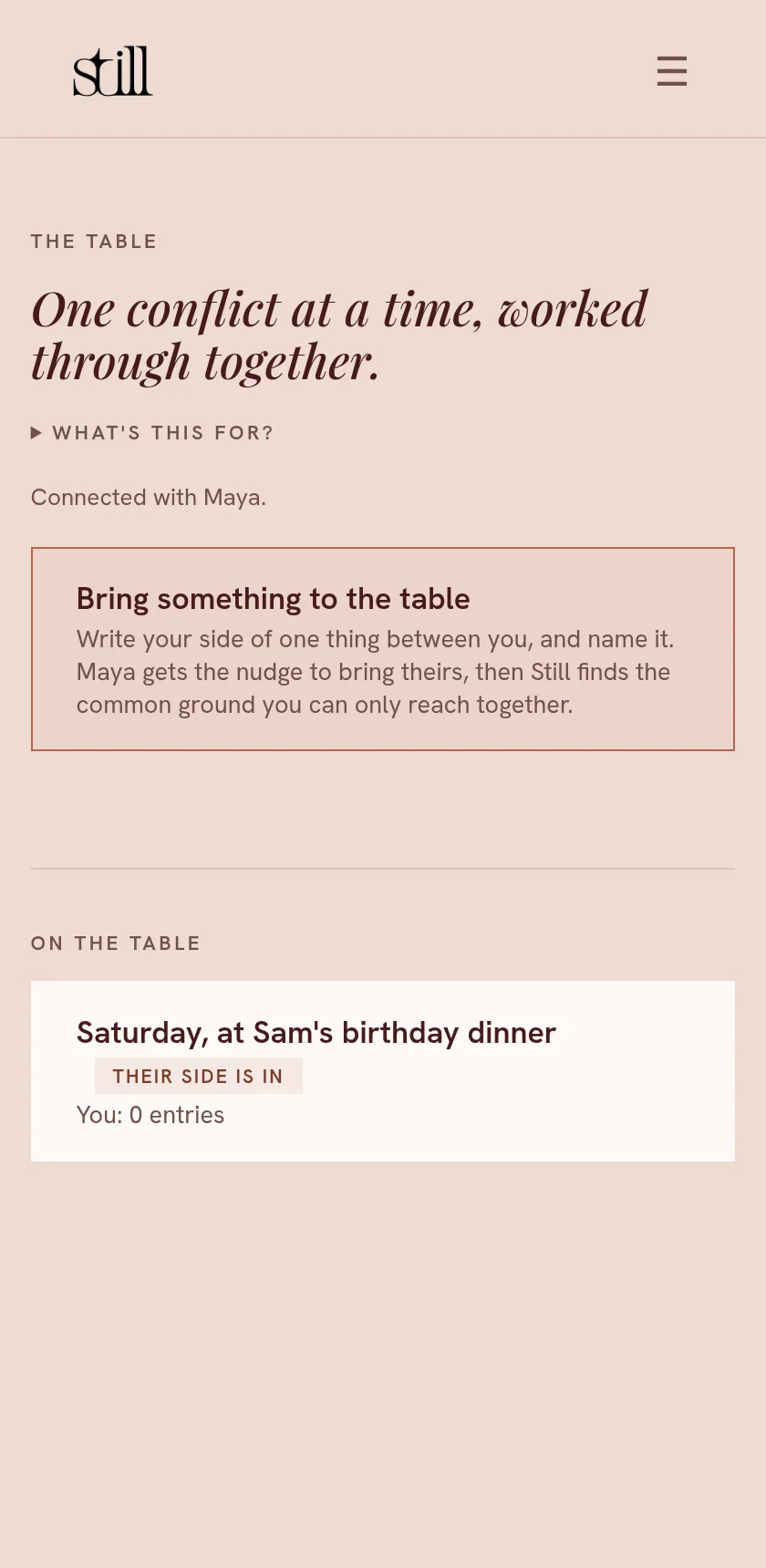
Moment oneMaya's side is down.
Her words sit under a heading that means exactly what it says: your entries — only you can see these. On Dan's Table there is one new thing: the name she chose. Her words are not on his screen, and there is nowhere on his screen they could be opened from.
Moment twoDan opens it.
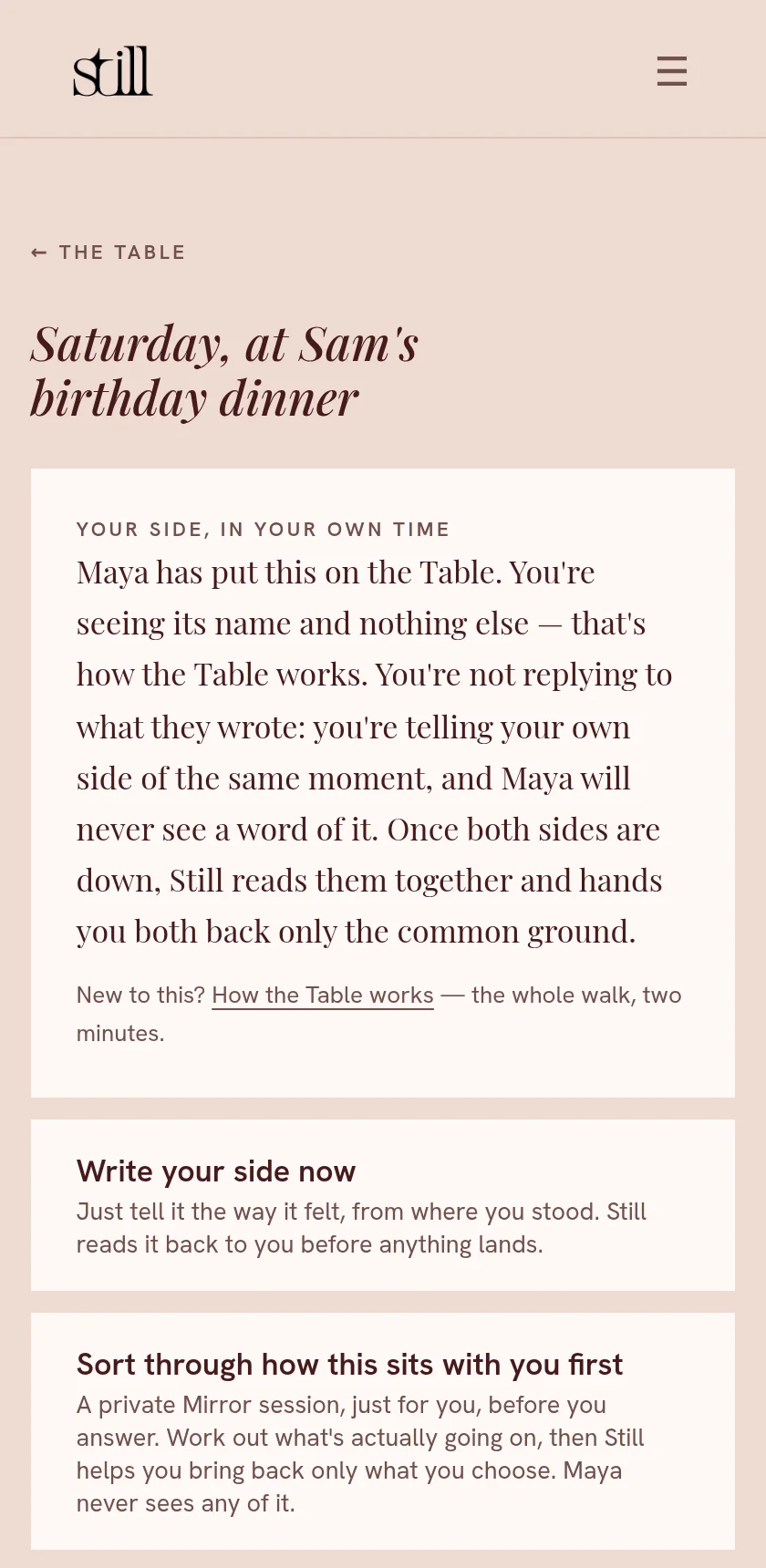
He gets the name, an explanation of what's being asked of him, and nowhere — anywhere — her words. He answers blind, on purpose: his own side of the same moment, not a rebuttal. And Maya's screen hasn't changed at all — she isn't told he's looked, because opening something shouldn't be a performance either.
Moment threeBoth sides are down.
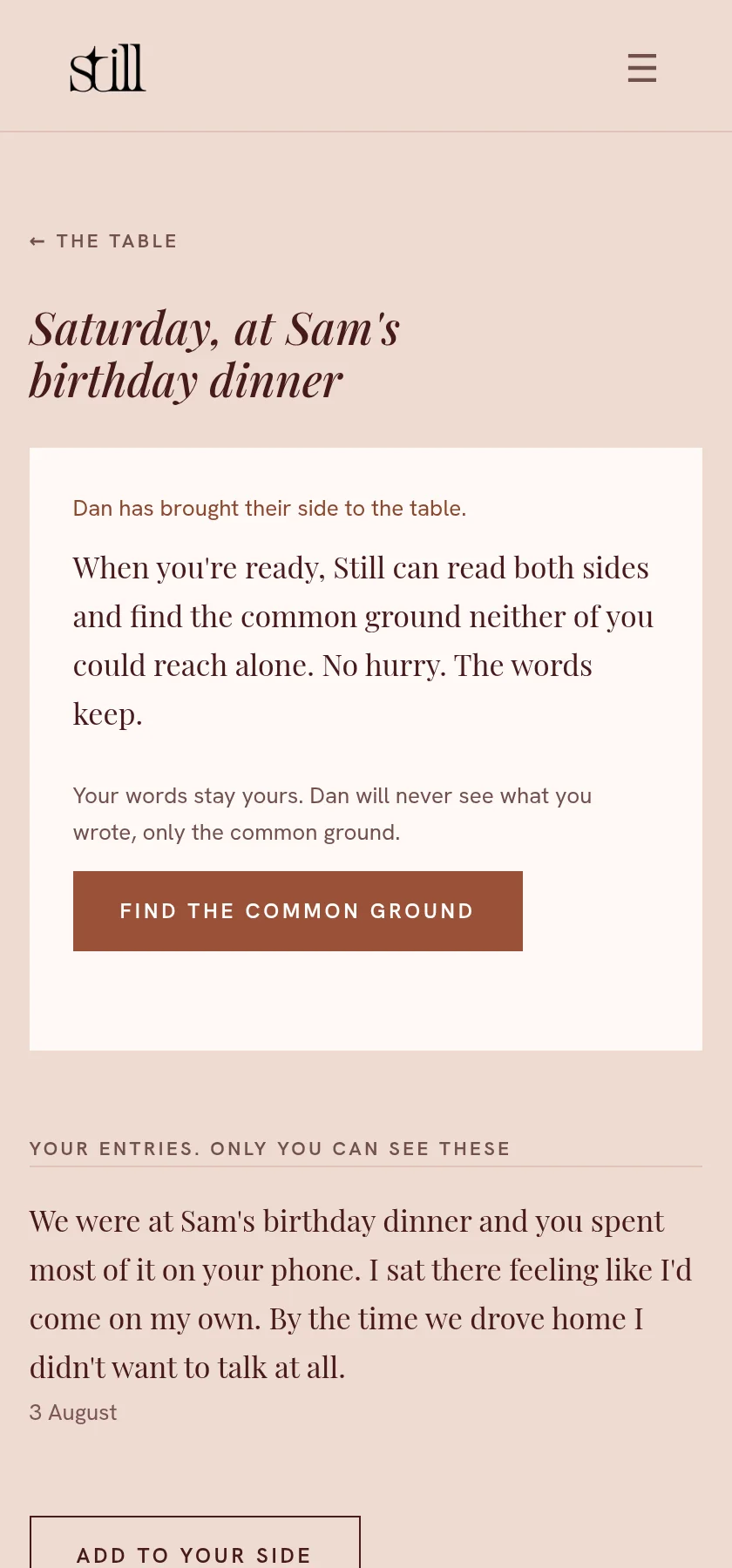
Each of them sees their own words, and a single line saying the other's side is in. Still not one word has crossed. The button that appears offers to find the common ground — it does not, and cannot, show anybody's writing to anybody.
Moment fourThe common ground.
One text, written by Still from both sides, lands on both screens at once — the first and only words they both see. It reflects what each of them said without handing either's words over: the engine is forbidden from quoting either account, and every common ground is measured against both accounts — every time, before either screen shows it. One that reuses someone's wording is rewritten; one that can't be fixed is thrown away. What Maya wrote stays on Maya's screen. What Dan wrote stays on Dan's. That doesn't expire.
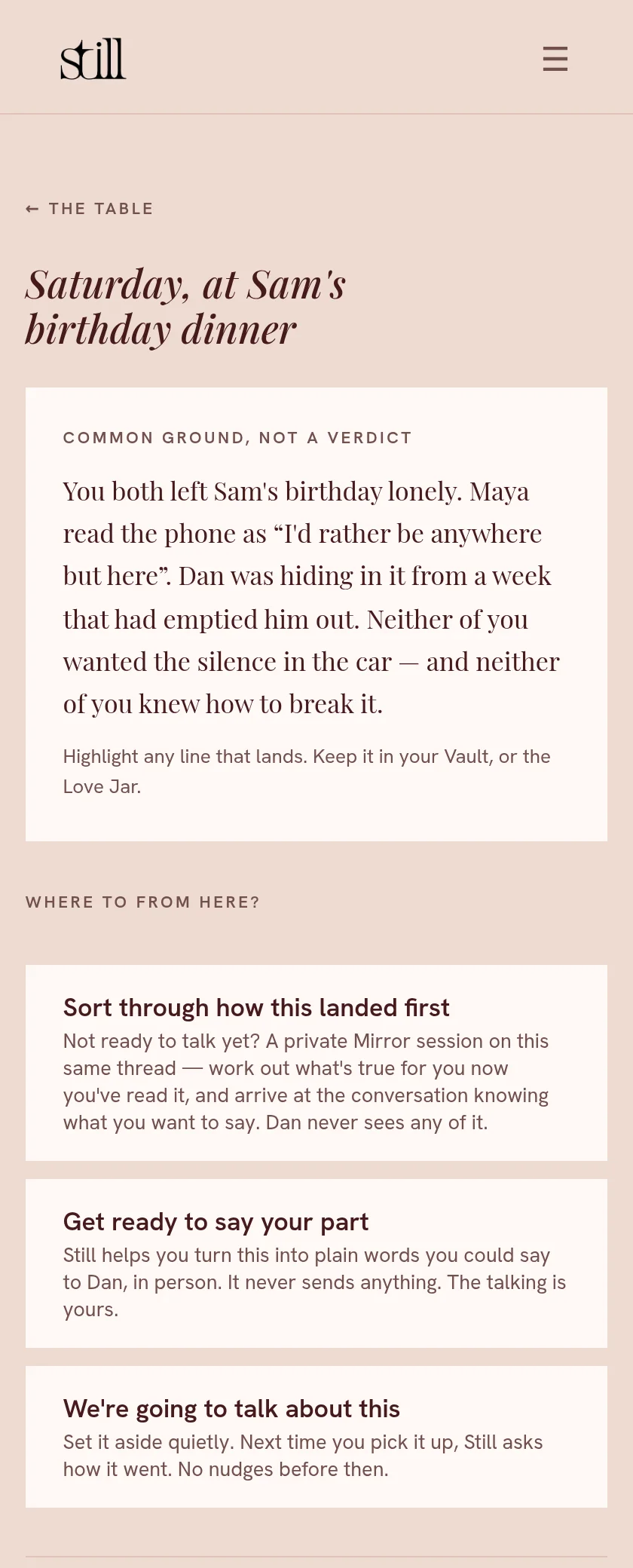
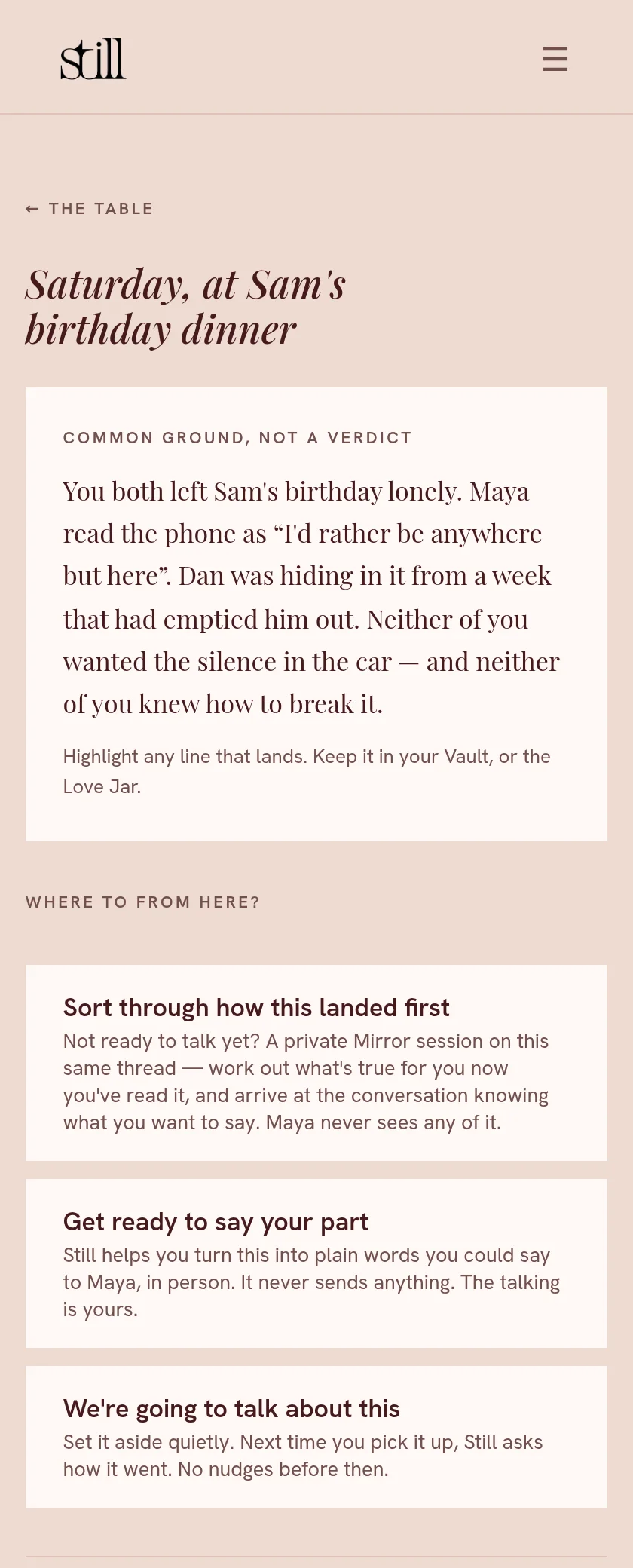
Maya and Dan are test accounts we keep for exactly this purpose — invented people, invented words. But the screens are the real product, photographed as it runs. When the product changes, these pictures are retaken.
The rules of the table
- Your words are never shown to your partner. The only things that ever cross: the thread's name, and the common ground you both receive at once. And the common ground is written fresh from both sides — it is forbidden from quoting either account, from reusing more than a few consecutive words of anyone's writing, and from repeating heated phrasing. That rule is checked mechanically on every common ground, before either of you is shown it: a summary that reuses your wording is rewritten, and one that can't be fixed is thrown away, not shown.
- Neither of you writes second. Whoever answers a thread does it blind — your side is your own telling, never a rebuttal.
- You can take it back. For the first few minutes after you put your side down, you can quietly withdraw it. Your partner is never told it was there.
- Finishing is yours alone. Putting a thread to the side moves it only for you. Your partner's side of the table is theirs to file.
- Still never sends a word on your behalf. It helps you get ready to say things in person. The conversation is yours.
The rest of the house
Every room, and what feeds what.
The Table is one room in a bigger house. Every visit starts at Home — the mood wheel. Burning goes straight to the Rant Room, warm goes to the Love Jar, everything else to The Sort — and from there each room passes work along only when you choose, in words you've approved. Tap a room to see what it does and where it feeds.
In the app itself the top bar carries just four places: Home, The Table, Us — your own rooms (the Vault, the Jar, your Mirror sessions, the Sort) open from there — and Account, where your settings and this guide live.
The same rooms, out of sight. You never see in; they never see yours.
- A thrown-away rant feeds nothing. There is nothing to find, anywhere — it never even left your device.
- Everything on your side stays on your side. Work travels only when you approve the exact words — to the Table as your side, or into getting ready to say it in person.
- The Table feeds the Us page. The common ground you make together becomes, over time, what's worth noticing between you. Curiosity, never verdicts.
- The Love Jar feeds the Us page. Moments you choose to send are read together, over time, for how each of you actually feels loved — named in your own words, not a category.
- Nothing shared ever reaches back into anything private. And the Us page never signals whether your partner has opened theirs.
No partner on Still yet? Every room on your side works on its own. The Table and the Us page open the moment they join.
Questions about privacy? It's written down, plainly.